The first and last lines of a letter carry more weight than their length suggests. In Italian they tell your reader how close you feel to them, how much respect you intend, and sometimes how much effort you made. Choosing Gentile instead of Caro, or Un caro saluto instead of Cordiali saluti, is a small decision that native speakers notice immediately.
This guide collects the greetings and closings you’ll actually use, sorted by register, with notes on when each one fits. It works for handwritten letters, emails and cards.
How to open a letter in Italian
For friends and family
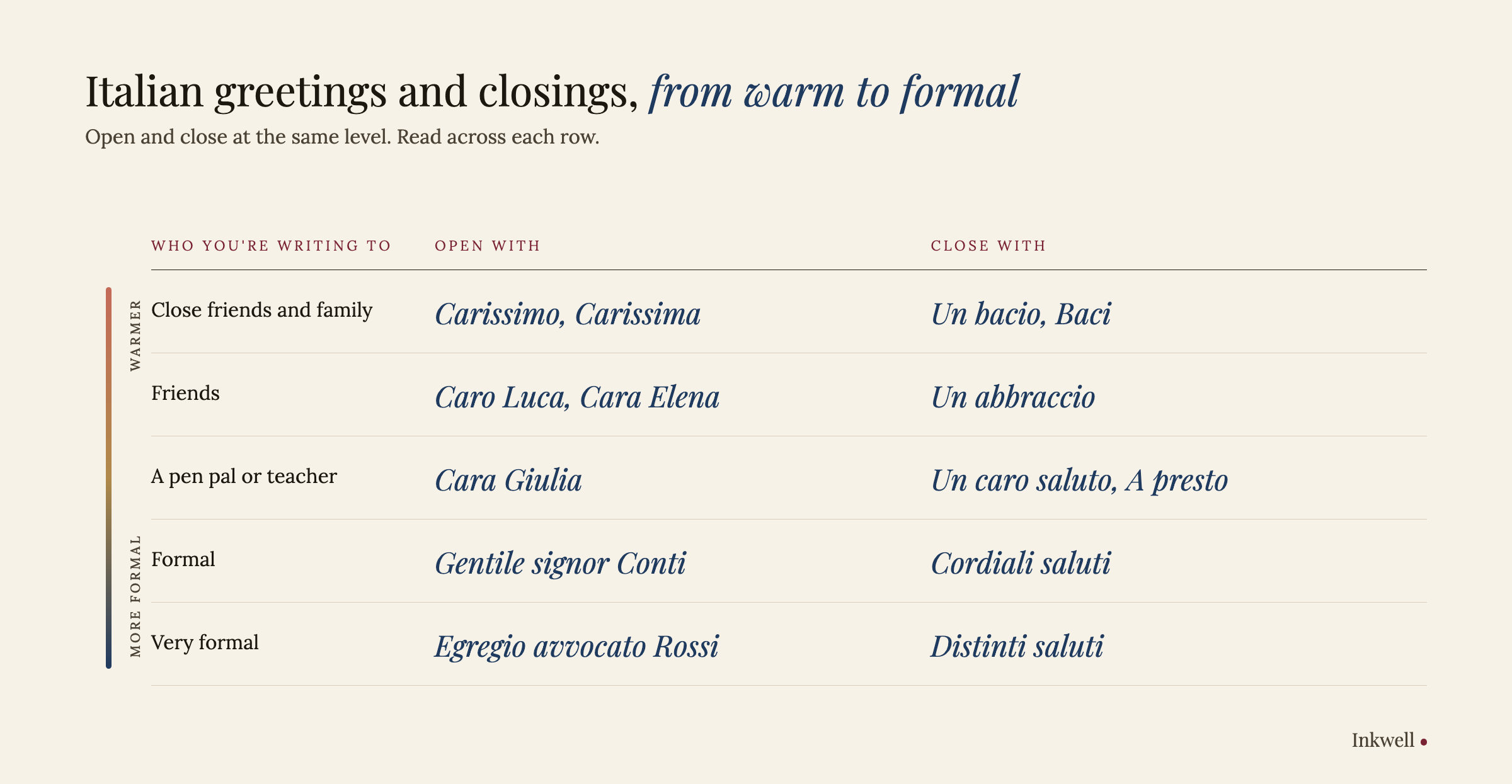
- Caro/Cara + name: the everyday opening. Caro Marco, Cara Elena. It is warm without being intimate, and it’s the right choice for most personal letters.
- Carissimo/Carissima: warmer. For close friends, family, or someone you haven’t written to in a long time.
- Cari/Care: for more than one person. Cari amici, Care tutte. With a mixed group, Italian traditionally uses the masculine plural, Cari.
- Ciao + name: perfectly normal in emails and messages between friends, less common at the top of a handwritten letter.
For someone you know, but not well
- Gentile + name is a useful middle ground: polite and personal at the same time. Gentile Laura, to a colleague you’ve met once, or a teacher you’ve just started writing to.
- Buongiorno/Buonasera is increasingly common at the start of professional emails, especially when you’re not sure how formal to be. It’s courteous and neutral.
For a formal letter
- Gentile signora/Gentile signor + surname: the standard for a stranger, an office or anyone in a professional role. Gentile signora Ferri, Gentile signor Conti.
- Gentile dottore/dottoressa, professore/professoressa: Italians use professional titles in formal writing, and dottore applies to anyone with a university degree, not only physicians.
- Egregio + title + surname: very formal, used for men. Egregio avvocato Rossi. Many Italians now find it stiff, so save it for letters that call for real ceremony.
- Spettabile (often written Spett.le): only for companies and institutions. Spett.le Ufficio Anagrafe.
Whatever the register, the greeting ends with a comma, and the first word of the letter starts in lowercase on the next line.
We explain that rule, and the rest of the layout, in how to write a letter in Italian.
How to close a letter in Italian
Closings follow the same logic as greetings: the warmer the relationship, the shorter and more physical the closing becomes.
Warm closings, for friends and family
- Un abbraccio: “a hug”. The most common warm closing, suitable for good friends and even friendly colleagues. Un abbraccio forte (a big hug) is warmer.
- Ti abbraccio: “I hug you”, slightly more personal.
- Un bacio/Baci: “a kiss/kisses”. For family, partners and close friends. Italians use it more freely than English speakers use “love”, but it still marks closeness.
- Con affetto: “with affection”. Gentle and a little old-fashioned, lovely in a handwritten letter.
- Tuo/Tua: “yours”, placed above the signature. Tua Elena.
Friendly and neutral closings
- A presto: “see you soon” or “talk soon”. It works almost everywhere except the most formal letters.
- Un caro saluto: “a warm greeting”. Polite and friendly, perfect for a teacher, an acquaintance or a pen pal you’ve exchanged a few letters with.
- Un saluto/Cari saluti: neutral and friendly. Saluti on its own can sound curt, so add cari or un caro.
- Alla prossima: “until next time”. Relaxed and conversational.
Formal closings
- Cordiali saluti: the standard formal closing, close to “Kind regards”. When in doubt in a formal letter or email, use this.
- Distinti saluti: more formal and more distant, close to “Yours faithfully”. Typical of letters to offices, banks and authorities.
- Con i migliori saluti: “with best regards”. Formal but warmer.
- La ringrazio e Le porgo i miei più cordiali saluti: an elaborate formula you’ll still see in official correspondence. You don’t need to produce it, but it’s good to recognize.
Putting them together
Greeting and closing should sit at the same level. A few combinations that work:
- Close friend: Carissima Anna, ... Un abbraccio forte,
- Pen pal or teacher: Cara Giulia, ... Un caro saluto,
- Acquaintance: Gentile Laura, ... A presto,
- Formal: Gentile signor Conti, ... Cordiali saluti,
- Very formal: Egregio avvocato Rossi, ... Distinti saluti,
Here is a short letter that keeps the register consistent from top to bottom:
Cara Giulia,
grazie per i consigli sul risotto: questa volta lo zafferano l’ho messo alla fine ed era perfetto! Ti mando una foto del piatto nella prossima lettera.
Un caro saluto,
Sarah
And the same message, rewritten for someone the writer has never met:
Gentile signora Bianchi,
La ringrazio per i Suoi consigli sul risotto. Li ho seguiti e il risultato è stato ottimo.
Cordiali saluti,
Sarah Miller
Notice how much changes beyond the first and last lines: grazie becomes La ringrazio, tuoi becomes Suoi, the exclamation mark disappears.
Common mistakes
- Caro for strangers. Caro signor Conti is not wrong, but in a first formal letter Gentile is safer and more natural.
- Distinti saluti to a friend. It sounds like a notice from the tax office.
- Saluti on its own. Add cari or un caro unless you mean to sound brief.
- A colon after the greeting. Italian uses a comma: Cara Anna, not Cara Anna:.
- Baci in a professional email. Even with a friendly colleague, un abbraccio or a presto is the safer warm option.
Write it in a letter
Choose three people in your life: a close friend, a teacher or colleague, and someone you’ve never met (a hotel, a language school, a landlord). Write a two-sentence message to each in Italian, with the right greeting and closing for each one, and keep the tu or Lei consistent in between.
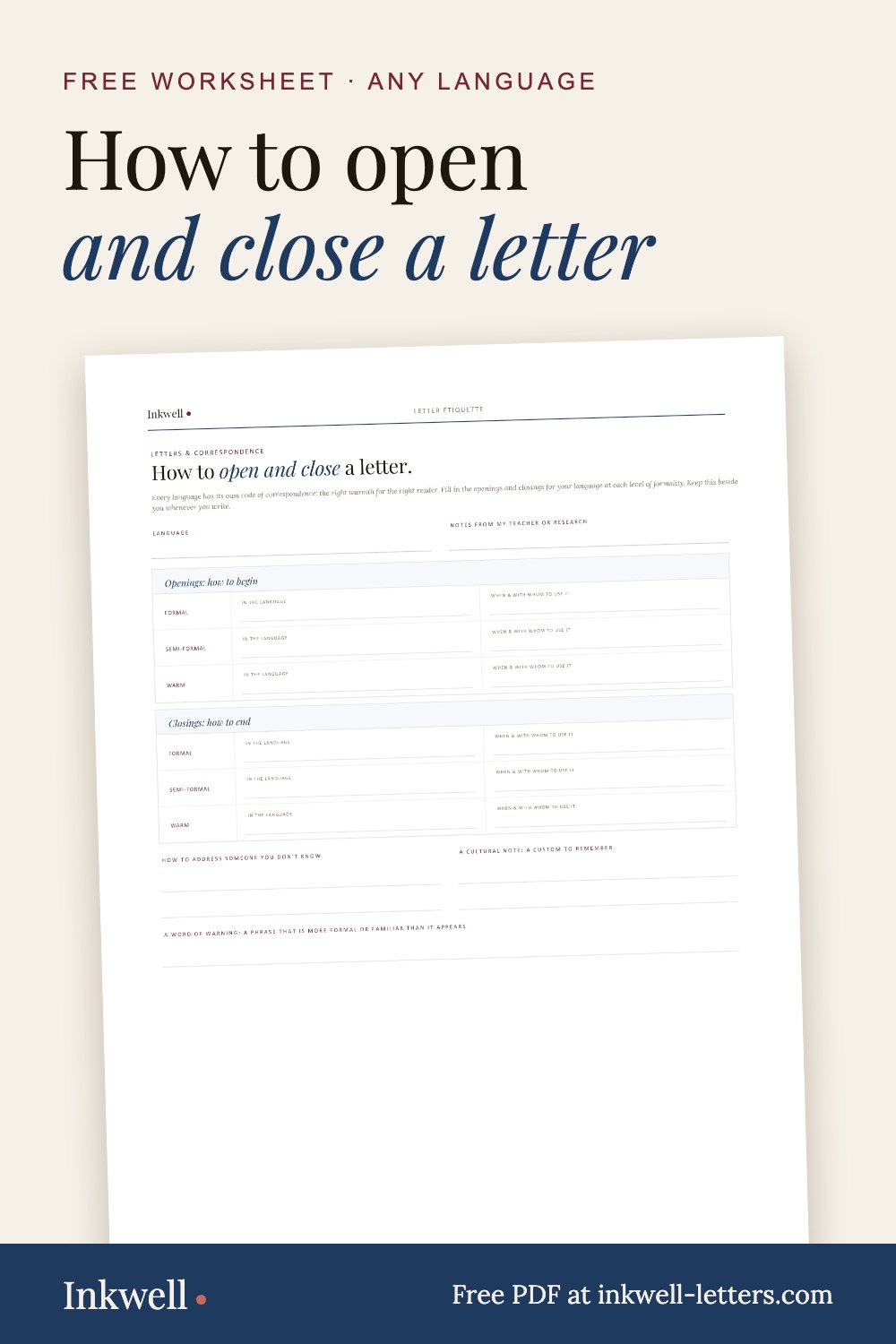
For quick reference while you write, download the Italian greetings and small talk cheat sheet, which puts formal and informal side by side. To build your own list of openings and closings, with notes on when to use each, use the open-and-close worksheet.
Learning the register from real letters
Lists like this one are a starting point. The register really sinks in when you see it used, letter after letter, by someone who writes to you. Inkwell teachers sign their letters, and adjust their closings, the way an Italian correspondent would, and they show you where your own register slips.
If you’d like to receive those letters by post and answer them by hand, you can learn Italian by letter with a native teacher.
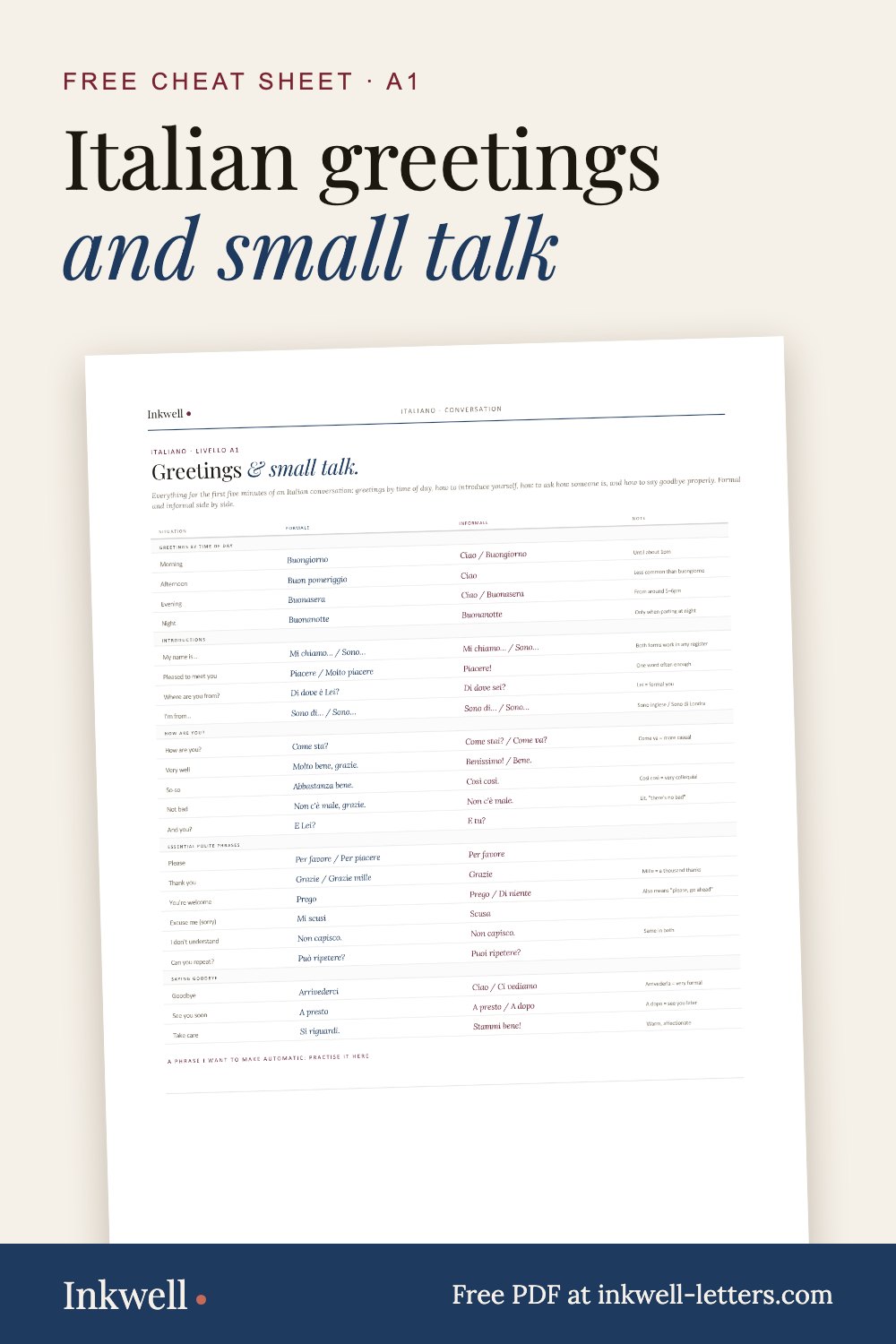 Italian Greetings and Small Talk: A1 Cheat Sheet
 How to Open and Close a Letter in Any Language