If you have felt the particular guilt of a lapsed streak, you already know something about duolingo burnout that no marketing page will tell you: it was never really about the language. It was about the app, and the small daily performance it asked of you. Somewhere between the first excited weeks and the day you finally let the notifications pile up unread, the goal quietly shifted from learning Italian to keeping a number from resetting to zero. That shift, more than any grammar point, is usually what breaks people.
This is not a failure of willpower. It is a predictable outcome of how these apps are built, and it is worth understanding exactly why, because the alternative to burnout is not more discipline. It is a different shape of practice altogether.
The Streak Trap: What the App Is Actually Optimizing For
Every design choice in a gamified language app, the streak counter, the daily goal, the push notification timed for the exact hour you usually check your phone, is built to solve one problem: getting you to open the app again tomorrow. That is a legitimate business problem for a company that sells subscriptions and ad impressions. It is not the same problem as helping you speak French at a dinner party.
Daily-open metrics and fluency are not the same target, and when a product has to choose between them, it chooses the one it can measure and monetize. So the app rewards you for showing up, not for understanding more. A five-minute session that matches ten words to pictures earns the same green checkmark as a session where you actually wrestled with a tricky subjunctive. The streak does not know the difference, and after a while, neither do you. You start playing the game the app is actually testing, which is attendance, and you quietly stop noticing whether you are learning anything at all.

What the Retention Numbers Actually Show
None of this is a secret, and it is not really a criticism unique to one company. It is closer to an admission built into the model. Language-app makers, including Duolingo in its own investor-facing materials, have long been candid that most people who download these apps do not stick around if citing numbers, else describe qualitatively and link to a reputable third-party analysis]. The honest, if unglamorous, picture across the category is a steep drop in the first days, a smaller cliff around the first month, and a long tail of casual dabbling for the small fraction who remain.
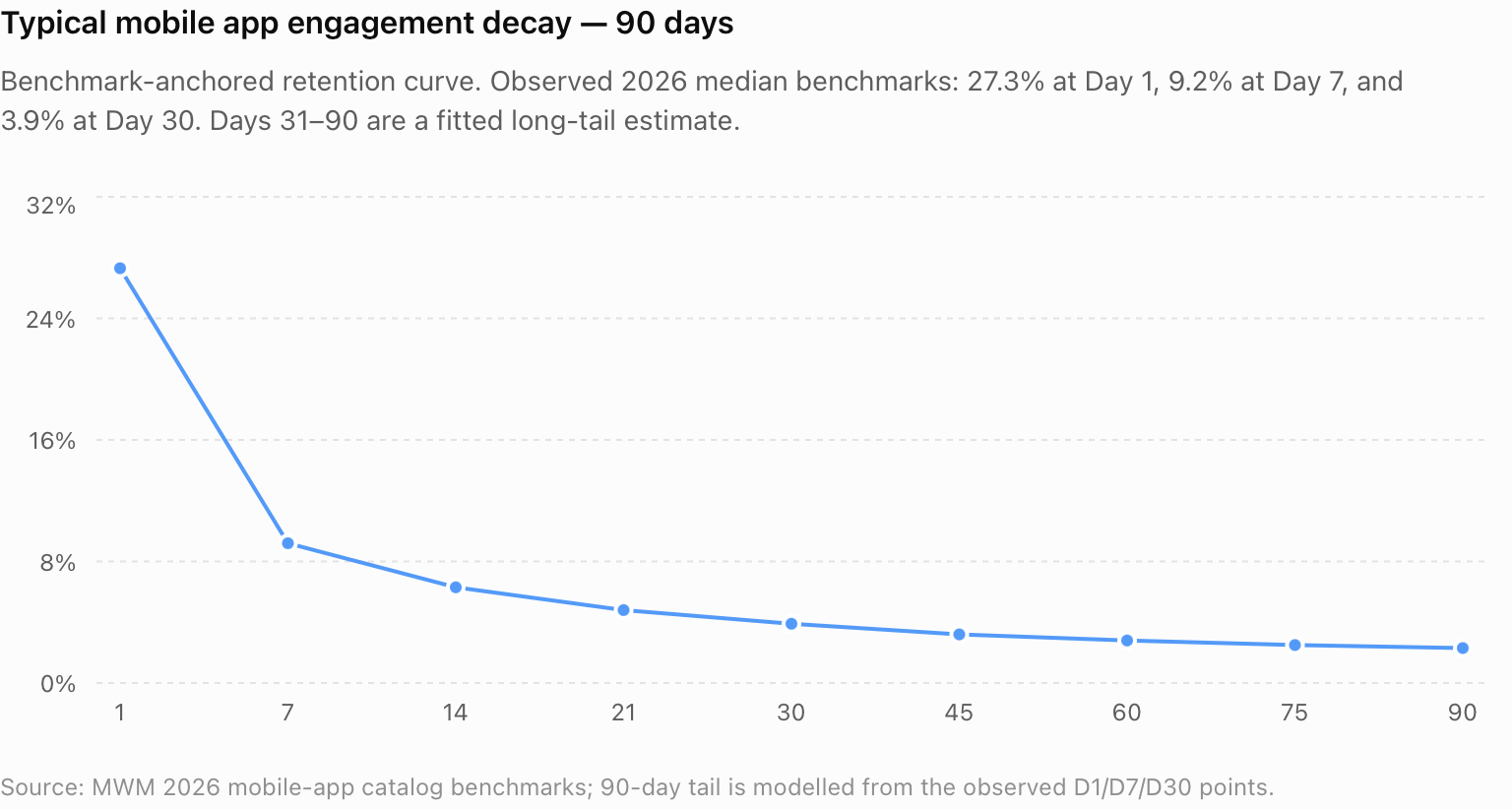
That is not a scandal. It is what happens when a product's core loop rewards novelty over depth. The first week of any new app feels like progress because everything is new: a new interface, a new small reward for each correct answer. But novelty has a half-life, and once it decays, what is left has to be the thing itself, actual engagement with a language, or there is nothing left to keep you coming back. For a lot of people, there wasn't.
Why Daily, Forever, Breaks Before It Builds
"A little every day" is good advice on its own. Turned into a permanent, unbroken obligation with a public score attached, it becomes something else: a low-grade source of guilt that never resolves. Habits that survive over years tend to have slack built into them. You can miss a day of a real habit and pick it back up without penalty. A streak has no slack. Miss one day and the number resets to zero, which means the emotional cost of missing a day scales with how long you have already been doing it. The longer you succeed, the more catastrophic a single lapse feels, until avoiding that feeling becomes more urgent than the learning itself.
This is precisely backwards from how skills are actually built. Real fluency accumulates unevenly: a good week here, a quiet month there, a sudden leap after a trip or a book or a long conversation with someone patient. A system that punishes that natural unevenness is not building a sustainable habit. It is building a countdown to the day you finally break it and, not incidentally, feel too discouraged to start again.
The goal was never the streak. It was always the language.
What Actually Builds Fluency
The linguist Stephen Krashen's comprehensible input hypothesis has held up remarkably well across decades of second-language research, and its core claim is almost embarrassingly simple: people acquire language by understanding messages that are just slightly beyond their current level, not by drilling isolated rules or racking up points. Meaning comes first. Repetition without meaning barely counts.
Match that against a typical app session and the gap is obvious. Tapping the correct translation of "the cat drinks water" for the fortieth time is not comprehensible input in any real sense; it is pattern matching against a closed set of possible answers. It can help with the earliest scaffolding of a language, but it plateaus quickly, because there is no message in it, nothing anyone is actually trying to tell you. What moves people forward is real content they care about, encountered often enough and with enough support to make sense of it: a letter, a conversation, a story, something written by an actual person with something to say.
A Slower Alternative: Learning by Correspondence
This is the idea behind correspondence-based learning, and it is closer to how language was taught for centuries before an app could measure your attention. Instead of a daily ping demanding a five-minute performance, you receive something with real weight: a letter, written by an actual native-speaking teacher, addressed to you, using language pitched just past what you already know. You read it, you sit with it, you reply in your own words and your own time, and someone reads what you wrote and responds to you specifically.
Spacing that would look like failure to a streak counter is simply how this works. A letter arrives every week or two, not every day, and that gap is not a design flaw; it is what gives you room to actually absorb what you read rather than skim it for a checkmark. There is no reset to fear, because there was never a counter running in the first place. What there is instead is a slowly thickening folder of real exchanges, in a language that was, at every step, trying to tell you something rather than testing whether you noticed.
Who This Suits, and Who It Doesn't
Correspondence learning is not the right fit for everyone, and it is worth saying so plainly rather than overselling it. If you want the dopamine of instant feedback on every sentence, or you are cramming for a trip next month and need rapid vocabulary triage, an app or an intensive course will serve you better in the short term. This is also not a method for people chasing a badge or a certificate; there is no leaderboard here, and that is rather the point.
Where it suits people is different: adults with some patience for delayed gratification, people who have already tried and quit an app once or twice and suspect the problem wasn't them, and anyone drawn to language less as a skill to be gamified and more as a way of actually reaching another person. If reading that description felt like relief rather than a chore, this is probably for you.
Your First Letter
You do not need another app to begin, and you certainly do not need a fresh streak to protect. What you need is a first letter, written to you, in a language you are ready to meet halfway. That is the entire mechanism: not novelty, not gamified guilt, just a real exchange with someone who is actually writing back. Start your correspondence, and see the plans, whenever you are ready to try something slower, and considerably more human, than a streak waiting to be kept.
Written by
The Inkwell Team
The Inkwell Dispatch
Written with care.
More from the Dispatch