A letter in Italian follows a few conventions that textbooks rarely spell out. Where the date goes. Why the first word after the greeting is lowercase. When Caro is too warm and Gentile too cold. How to close without sounding like a bank. None of it is difficult, and once you know the pattern you can write a real letter at A2.
This guide walks through an Italian letter from top to bottom, with two complete examples, one informal and one formal, and a short exercise at the end.
The shape of an Italian letter
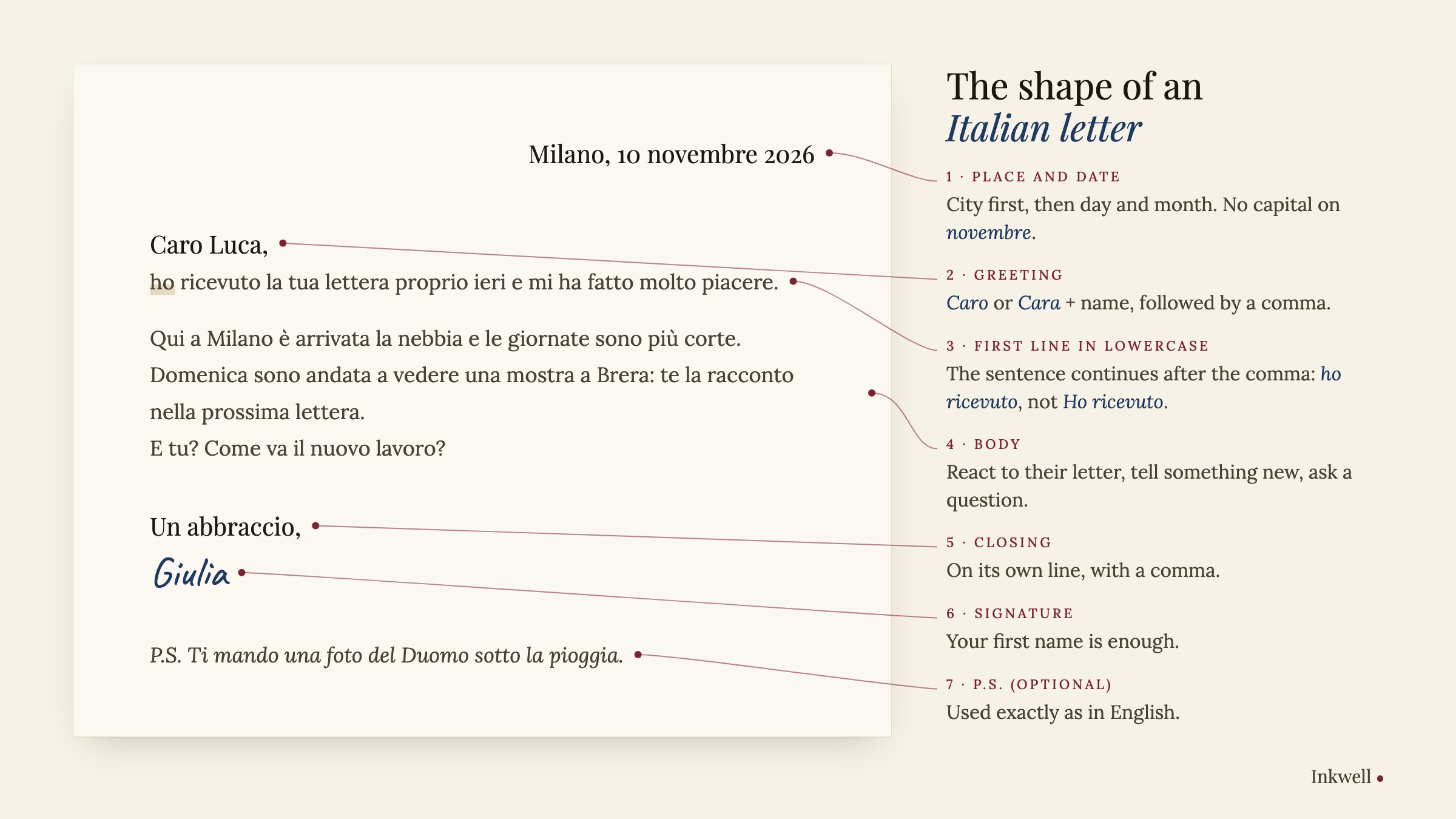
Every Italian letter, informal or formal, has the same skeleton:
- Place and date, top right
- The greeting, followed by a comma
- The body, starting on a new line with a lowercase letter
- The closing, on its own line
- The signature
- An optional P.S.
Let’s take them one at a time.
Place and date
Italians write the city first, then the date, with the day before the month and no capital letters:
Milano, 10 novembre 2026
Months and days of the week are not capitalized in Italian and the first of the month is always primo: 1° dicembre or primo dicembre. In an informal letter you can drop the year.
The greeting
The greeting depends on how well you know the person and how formal the letter is.
- Caro/Cara + name is the standard for friends, family and anyone you’re on first-name terms with: Caro Luca, Cara Giulia. For more than one person, Cari amici or Care ragazze.
- Carissimo/Carissima is warmer still, for close friends and family.
- Gentile + title + surname is the safe choice for someone you don’t know, or in any formal letter: Gentile signora Rossi, Gentile dottor Bianchi. It works for men and women.
- Egregio (distinguished) still appears in very formal letters to men, often abbreviated Egr. It sounds old-fashioned to many Italians, so use it only when the situation calls for real ceremony.
The greeting ends with a comma, never a colon.
The first line starts in lowercase
Because the greeting ends with a comma, the sentence continues on the next line, and the first word is always lowercase:
Cara Giulia,
ho ricevuto la tua lettera proprio ieri.
The body: tu or Lei?
Before you write a word, decide whether you are writing with tu (informal “you”) or Lei (formal “you”). In a letter to a friend, a teacher who has invited you to use tu, or anyone your age in a relaxed context, it’s tu. To a stranger, an office, a landlord, or an older person you don’t know, it’s Lei, with the verb in the third person: Come sta? instead of Come stai?
In very formal letters many writers still capitalize the pronoun and its forms as a mark of respect: La ringrazio, Le scrivo. It isn’t required, but it’s common.
Whichever you choose, stay with it. Switching between tu and Lei in the same letter is the most frequent error in learners’ formal letters.
A good body paragraph in an informal letter usually does three things:
- reacts to the other person’s last letter
- tells them something specific about your life
- asks a real question
A few phrases you’ll use again and again:
- Grazie per la tua lettera. (Thank you for your letter.)
- Che bello avere tue notizie! (How lovely to hear from you!)
- Ti scrivo per raccontarti... (I’m writing to tell you...)
- Scusa se ti rispondo solo ora. (Sorry I’m only answering now.)
- E tu, come stai? (And you, how are you?)
The closing
The closing sits on its own line, usually followed by a comma, then your name below it. As with the greeting, the right choice depends on the relationship:
- Informal: A presto, Un abbraccio, Un caro saluto, Un bacio (for family and close friends)
- Neutral: Un saluto, Cari saluti
- Formal: Cordiali saluti, Distinti saluti, Con i migliori saluti
We go through these one by one in our guide to Italian letter greetings and closings.
Example 1: an informal letter
Here is a short letter a learner at A2 or B1 could write to a correspondent or pen pal.
Sarah
This is the kind of letter Inkwell students write in their first months. The teacher replies to the content, the risotto and the saffron, and corrects the language around it. If you’d like to write letters like this to a native teacher and have them answered by post, you can learn Italian by letter.
Example 2: a formal letter
Formal letters are shorter, more predictable and use Lei. Here is a polite request to a language school.
Michael Turner
Addressing the envelope
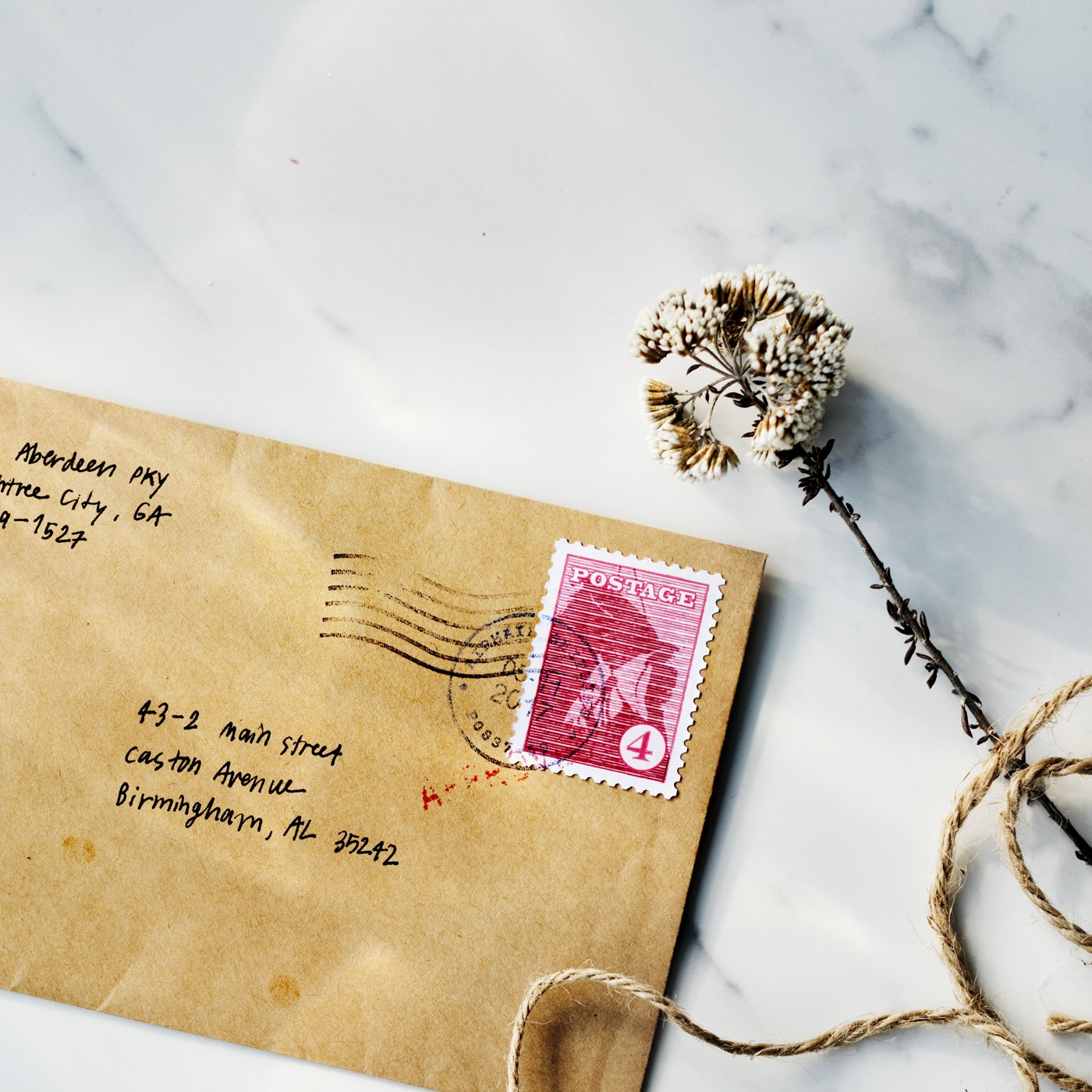
If you’re sending your letter to Italy, the envelope follows its own order:
Gentile Sig.ra Giulia Bianchi
Via Garibaldi 15
20121 Milano MI
ITALIA
- The street name comes before the number: Via Garibaldi 15.
- The five-digit postal code (CAP) comes before the city.
- The province abbreviation follows the city in capitals: MI for Milan, RM for Rome.
- Write the country in capitals on the last line.
- Courtesy titles are common on envelopes: Gentile Sig. (Mr.), Gentile Sig.ra (Mrs. or Ms.).
Your own address goes on the back of the envelope in Italy, after the word Mittente (sender).
Five mistakes to avoid
- Capitalizing the first word after the greeting. Cara Anna, ho letto... not Ho letto.
- Mixing tu and Lei. Decide before the first line and keep to it.
- Using Caro for a stranger. In a formal letter, Gentile is safer.
- Capitalizing months and days. martedì 10 novembre, never Martedì 10 Novembre.
- Closing a friendly letter with Distinti saluti. It reads like a letter from an insurance company.
Write it in a letter
Here is a short exercise to put this into practice. Write a letter of six to eight sentences to an imaginary Italian correspondent, using this structure:
- Place and date, Italian style
- Cara/Caro + name, with a lowercase first line
- One sentence reacting to a letter they “sent” you (invent something they told you)
- Two sentences about your week, with one verb in the passato prossimo
- One real question for them
- A warm closing and your name
To help you structure it, download the free letter reply template, which breaks a reply into four short movements: an opening, a discovery, a question and a close. If you prefer to keep track of the expressions you learn along the way, the annotated letter page gives you a margin for vocabulary and corrections.
Where to go from here
Once you have the shape of a letter, what makes it good is practice and a reader who writes back. A pen pal can give you the second half, but a teacher can give you both the reply and the corrections.
At Inkwell, a native Italian teacher in Italy writes you a letter by post, adapted to your level, and replies to every letter you send back, with notes on your grammar and a little culture in each envelope. If that sounds like the way you’d like to learn, read more about how to learn Italian by letter with a native teacher.
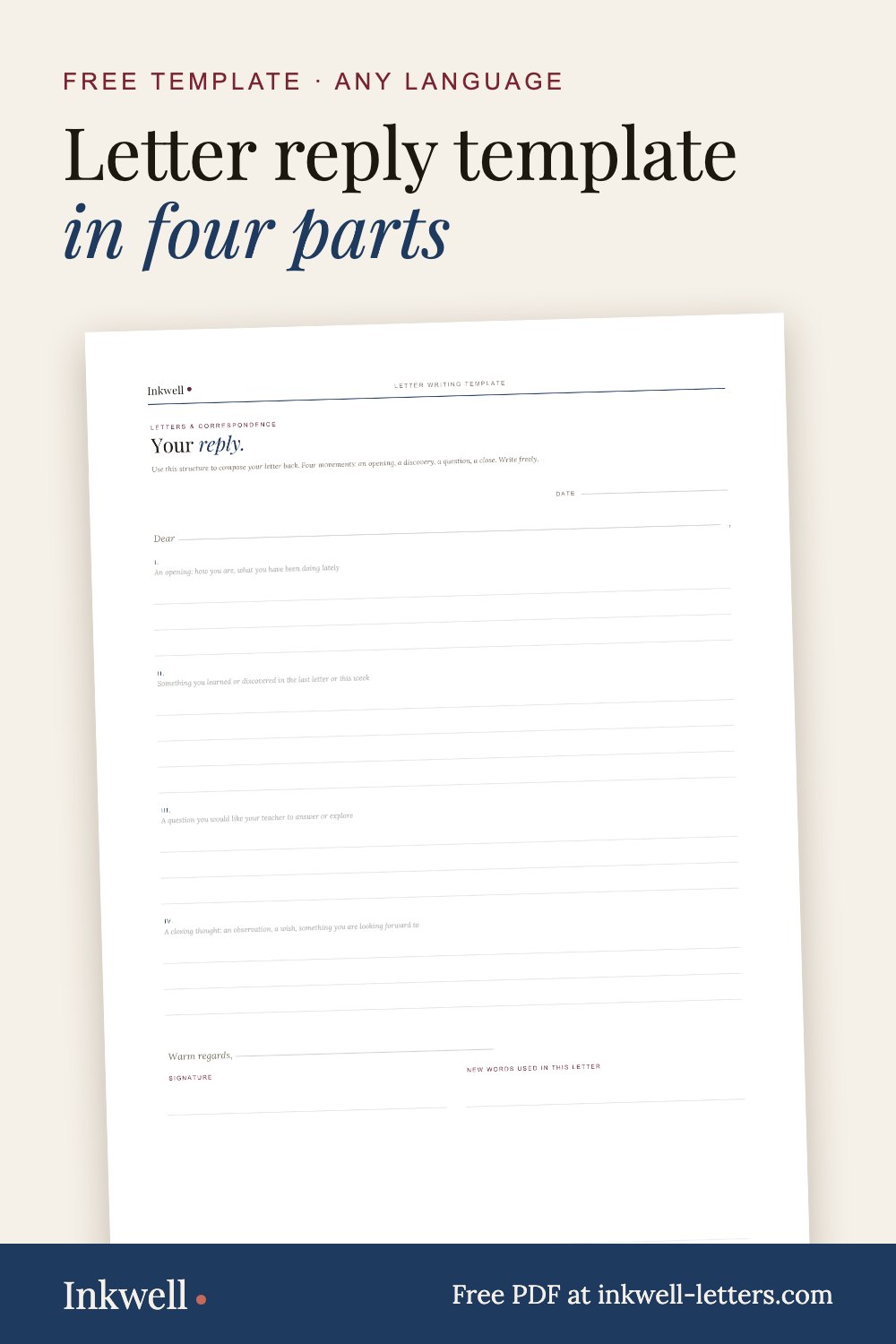 Letter Reply Template: Four Movements for Writing Back
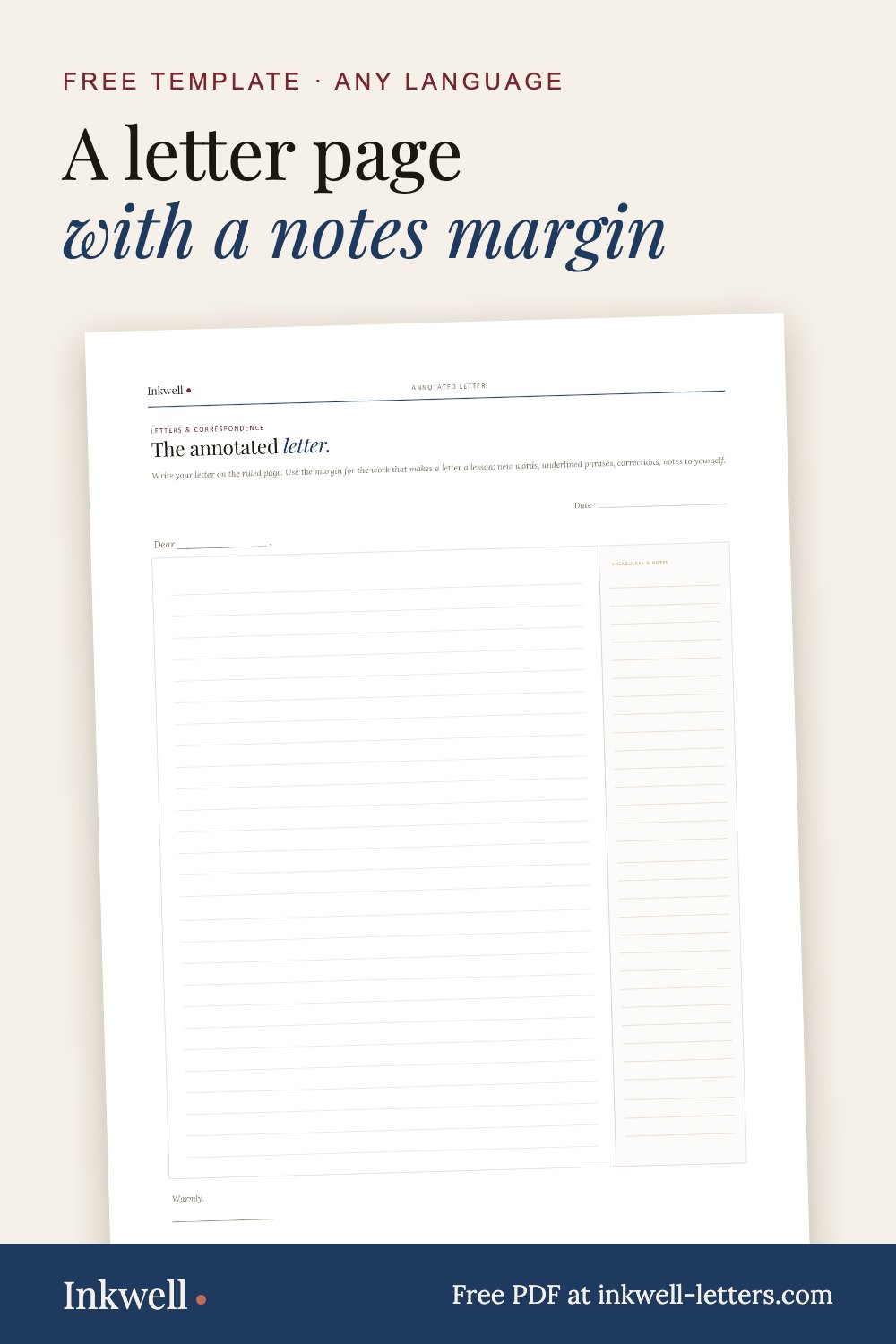 The Annotated Letter: A Writing Page With a Notes Margin