
The best gift for someone learning Italian is one they will use after the wrapping is gone. A book they keep on the desk, an evening that makes them speak, or a reason to write in Italian every month.
The short answer: match the gift to their level and their habits. For beginners, a good graded reader or a cooking class taught in Italian. For learners who already read a little, a monolingual dictionary, a novel in easy Italian, or something that asks them to write: a notebook, a pen pal, or a correspondence with a teacher in Italy. The rest of this guide goes through each kind of gift, with what it does well and where it falls short.
Start with their level and their habits
Two questions narrow the choice quickly.
How much Italian do they have? A complete beginner needs structure: a course book, an app, a class. Someone who can read a short paragraph with a dictionary is ready for real material, and for gifts that ask them to produce Italian, in writing or out loud.
How do they like to learn? Some people study on the train with a phone. Others want a desk, paper and a quiet hour on Sunday. A gift that fits the habit gets used; a gift that asks them to change it usually ends up on a shelf.
If you’re not sure of their level, ask what they’re reading or studying at the moment. That one answer tells you most of what you need.
Books that earn a place on the desk
Books are the safest gift for a learner, as long as they match the level.
- Graded readers. Short novels written for learners, sorted by level. Alma Edizioni’s Italiano facile series runs from beginner to upper intermediate, and the stories are written for adults. A reader one level below where they think they are is a pleasure; one level above is homework.
- A monolingual dictionary. For intermediate learners, an Italian dictionary in Italian, such as lo Zingarelli, is a quiet milestone. It means they look words up in the language itself.
- A novel they already know. An Italian translation of a book they love in English is easier than it sounds, because they already know the story and can follow the language.
- A grammar they will actually open. Choose a reference with exercises and an answer key over a large academic grammar. Ask which course book they use and look for the matching workbook.
The drawback of books is that they’re solitary. They build reading, which is the easiest skill to keep, and leave writing and speaking to chance.
Things for the writing desk
People who learn with paper love good paper. A notebook with ruled pages for vocabulary, a fountain pen, a set of postcards to write in Italian: small gifts, but they make a study hour feel like an occasion.
If you’d like to add something useful, print a few free sheets to go with the notebook. Our free Italian letter-writing worksheets cover greetings, closings, prompts and planners, and most of them work for any level from A2.
Experiences: a class, a dinner, a trip
An experience gives the learner a reason to use Italian with other people.
- A cooking class taught in Italian. Many cities have them, often through an Italian cultural association. The vocabulary is concrete and the reward is dinner.
- A course at a cultural institute. The Istituti Italiani di Cultura abroad and local chapters of the Società Dante Alighieri run courses at every level, with a structure that suits beginners.
- A trip, or part of one. A weekend in Italy is the most expensive idea here, and for many learners the one that motivates them most. A smaller version: a voucher for an Italian restaurant, with the promise that they order in Italian.
Experiences are memorable but brief. Pair one with something that lasts, like a book or a regular correspondence, so the motivation has somewhere to go afterward.
Lessons, apps and courses
Apps and online lessons are the gifts most people think of first, and they have real strengths. An app is cheap, available anywhere, and good for vocabulary and daily contact with the language. Online tutors give speaking practice that books and letters can’t.
They also have limits worth knowing before you buy. Apps rarely ask the learner to write more than a sentence at a time, and an app is easy to put down once the novelty fades. Tutoring depends on finding a teacher and a time slot that suit them, every week. If the person you’re buying for has started and abandoned an app before, choose something different this time.
A gift that arrives by post: letters from Italy
This is the gift we make at Inkwell, so take this section as our view and judge it with that in mind.
An Inkwell gift is a correspondence. A native Italian teacher living in Italy writes letters to the person you choose, at their level, about the things they care about. They write back, and the teacher answers with the next letter, with notes on their Italian. On the postal plans the letters travel by post from Italy; Digital Dispatch delivers them to an online dashboard.
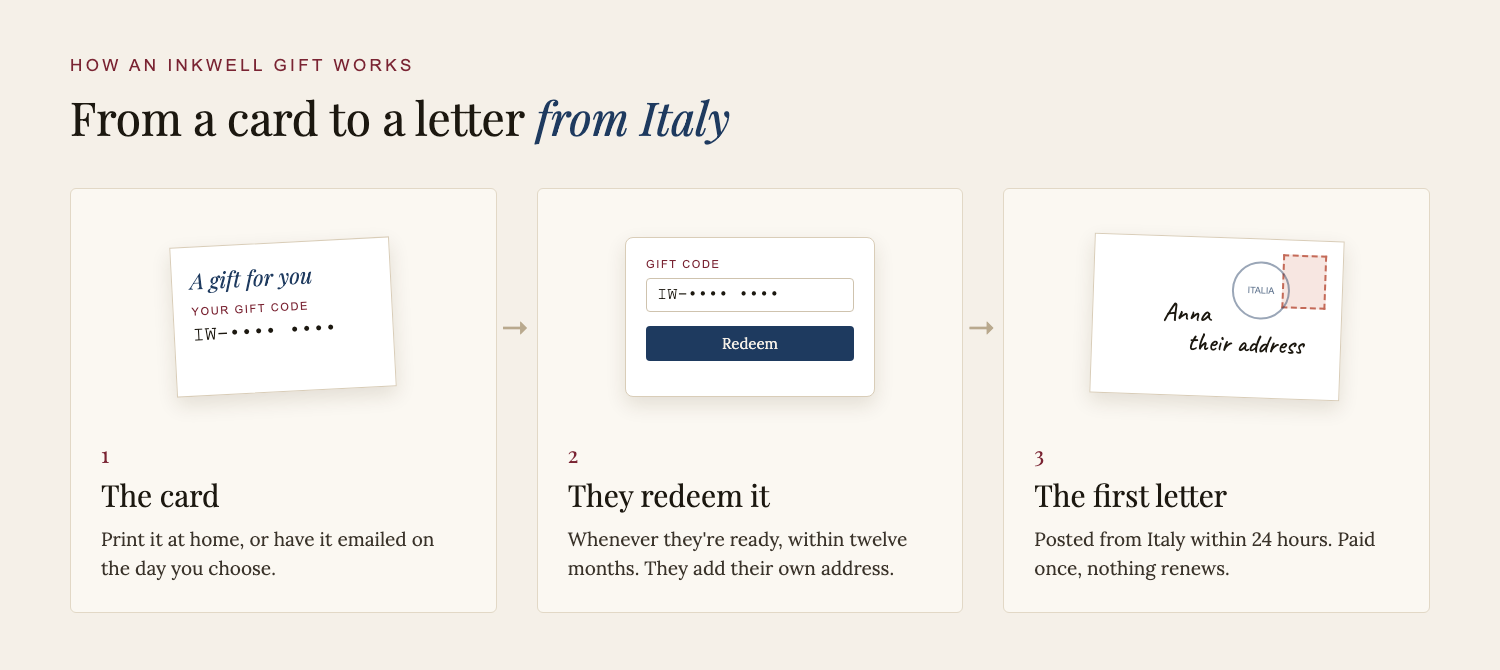
How it works:
- You choose a plan and a length: 3, 6 or 12 months.
- You print the card at home (one A4 sheet that folds into a card) or have it emailed on the date you choose. From 15 November to 6 January there’s a Christmas design.
- They redeem the code whenever they’re ready, within twelve months, and add their own address. You don’t need it.
- Their first letter is posted from Italy within 24 hours of redeeming.
- It’s paid once and ends on its own. Nothing renews and nothing is charged to them.
What it costs, paid once:
- Digital Dispatch, one digital exchange a month: €39 for 3 months, €72 for 6, €120 for 12
- Correspondent, one exchange a month by post: €81, €150, €276
- Pen Pal, one exchange a month by post, with exercises corrected by hand: €144, €264, €480
- Immersive, two exchanges a month by post, with priority tracked shipping: €249, €456, €852
Where it falls short. It isn’t for complete beginners: they should be able to read a short paragraph with a dictionary. There’s no speaking practice. And letters are slow by design, so a correspondence suits someone who enjoys taking their time more than someone in a hurry before a trip. Typical delivery times are 3 to 8 working days within Europe and 6 to 16 to the US and Canada.
If that sounds like the person you have in mind, you can give letters from Italy as a gift, or read more about learning Italian by letter.
What to write in the card
Whatever you give, the note matters. A few lines in Italian, even simple ones, tell the person that you’ve noticed what they’re doing. Here is an example, from a friend who knows a little Italian:
Marco
Short is fine. If your Italian stops at ciao, write the note in English and add one line in Italian at the end: Buono studio (enjoy your studying) or A presto in italiano (see you soon, in Italian).
For more ways to open and close, our guide to Italian letter greetings and closings sorts them from the warmest to the most formal.
Write it in a letter
If you’re giving a language, write the letter that goes with it. Use these four questions, in English or in Italian:
- Why this language, for them in particular
- What you’ve noticed about them and Italy: a trip, a book, a grandparent
- What you hope they’ll feel when the first letter arrives
- A close that fits how you usually sign off to them
Download the free gift letter template: it has a page for exactly these four parts, with space to write by hand and slip it in with the card.
And if you’re the one learning Italian and hoping someone takes the hint, send them this article. Or start your own correspondence: you can learn Italian by letter with a native teacher, and write the first reply yourself.
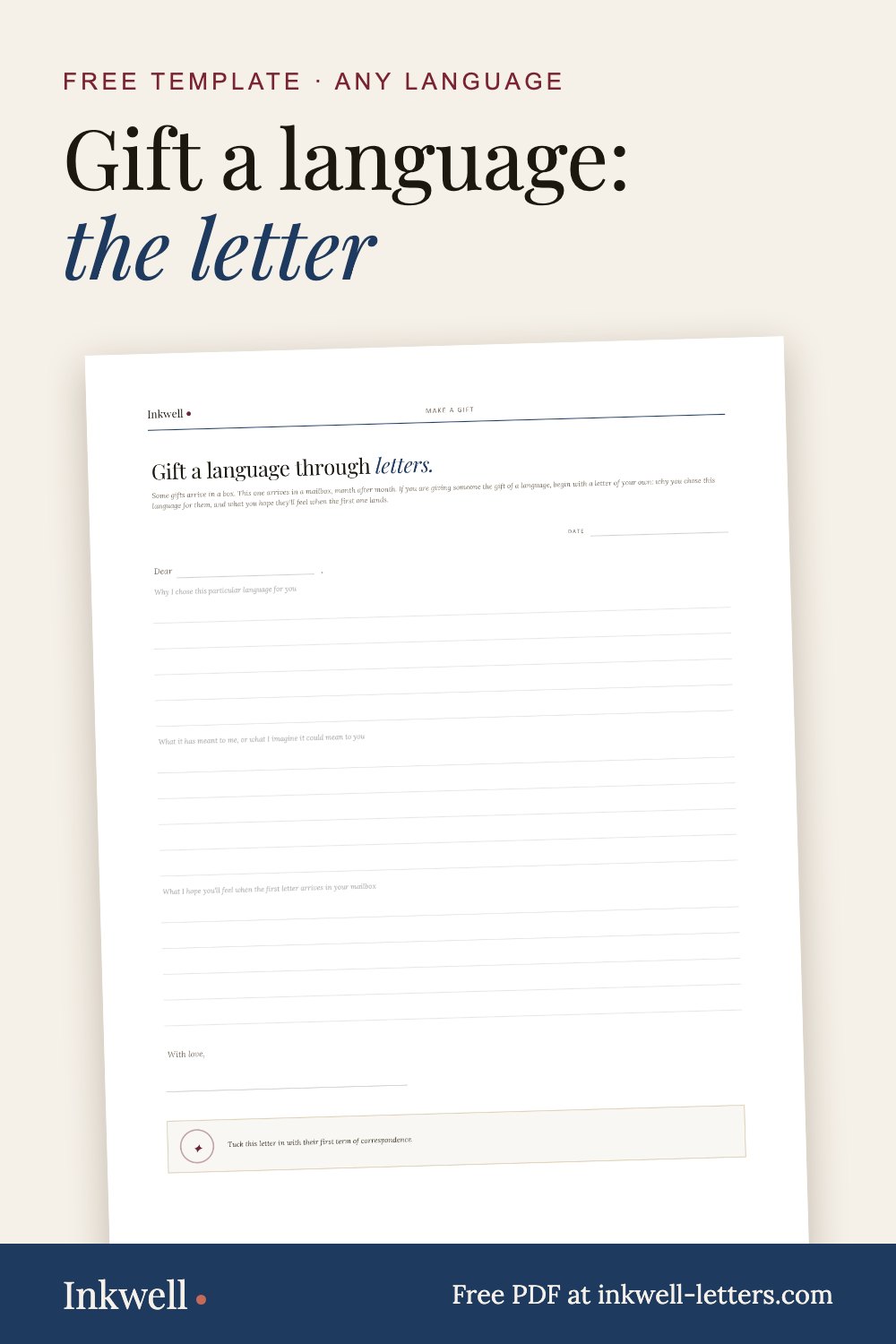 Gift a Language: A Letter to Go With the Gift

Comments