
Duolingo has introduced millions of people to Italian, and for many of them it was the first time learning a new language. It’s very good at what it was built for: a short daily habit, a steady flow of vocabulary, and the satisfaction of a streak.
At some point, though, many learners want something the app isn’t designed to give: longer texts, real conversations, writing that someone actually corrects.
The short answer: for speaking, an online tutor; for structure, a class; for listening, podcasts; for reading, graded readers; for writing and correction, a correspondence with a teacher. Most learners do best with two of these together. Below, each option with what it does well and where it falls short.
We wrote separately about why so many people burn out on language apps. This piece is practical: what to do next.
First, decide what you want to improve
Every method trains some skills more than others. Before choosing, ask yourself which of these you most want to work on:
- Reading and vocabulary
- Listening
- Speaking
- Writing
- Being corrected, consistently, by someone who knows the language
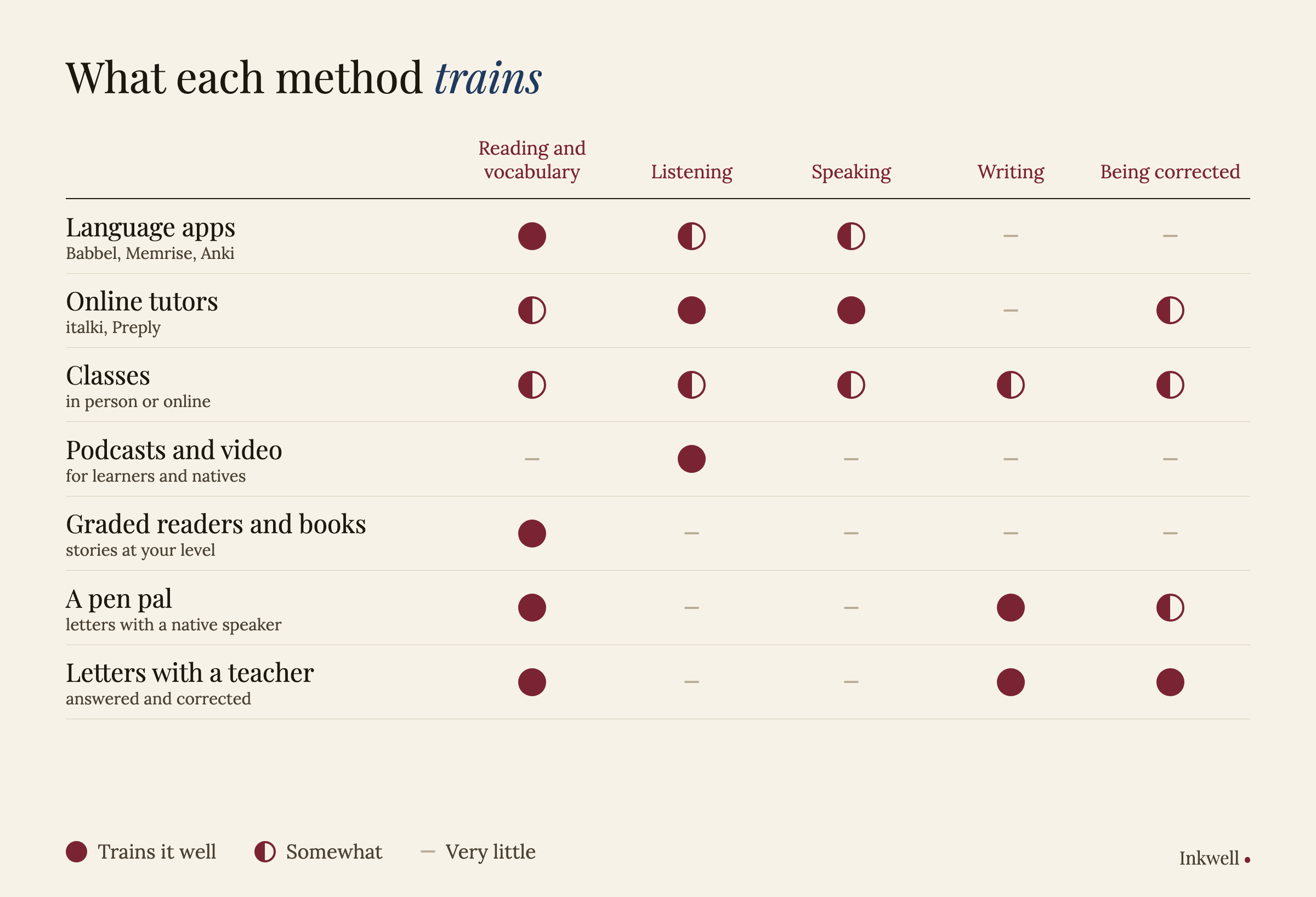
Most learners who leave an app behind are looking for one of the last three.
Other apps
If you like the app format but want more structure, there are alternatives with a different approach.
- Babbel builds its lessons around dialogues and explains grammar more explicitly, which suits learners who want to understand why a sentence works.
- Memrise focuses on vocabulary, with clips of native speakers saying everyday phrases.
- Anki is a free flashcard system, not a course, but many serious learners use it to review the words they meet elsewhere.
Good for: vocabulary, daily habit, beginners. Less good for: writing at length and personal correction.
Online tutors
Platforms such as italki and Preply connect you with Italian teachers and conversation partners for one-to-one video lessons, usually bookable by the hour.
Good for: speaking, listening and confidence in conversation, especially at B1 and above, and for learners preparing for a trip. Less good for: learners who find video calls stressful, or whose schedule makes fixed appointments difficult. Corrections happen in the moment and are easy to forget unless you take notes.
Classes
The Istituti Italiani di Cultura abroad, local chapters of the Società Dante Alighieri, universities and community colleges all offer Italian courses, in person and online.
Good for: structure, a group, a clear progression through the levels, and preparation for certificates such as CILS and CELI. Less good for: individual attention, since a class moves at the pace of the group.
Podcasts and video
Italian has an excellent range of learner podcasts and channels. Coffee Break Italian takes you from zero in short episodes; Easy Italian films real conversations on the street with subtitles. Many native podcasts are within reach at B1.
Good for: listening, pronunciation, culture, and learning in moments when you can’t sit at a desk. Less good for: speaking and writing, which need you to produce the language yourself.
Graded readers and books
Graded readers are stories written for learners at a specific level, so you can read for pleasure without a dictionary on every line. Collections of short stories for beginners and intermediate learners are easy to find for Italian, and at B2 you can move on to contemporary novels.
Good for: vocabulary in context, grammar by exposure, and the quiet pleasure of finishing a book in another language. Less good for: active practice, unless you write about what you read.
Writing, and letters
Writing is the skill apps train least and learners practice least, and it’s often the one that moves everything else forward. When you write, you have time to build sentences properly, to look up the word you need and to notice the gap between what you want to say and what you can say. That gap is exactly where learning happens.
The problem with writing on your own is that nobody reads it. That’s what a correspondence fixes.
A letter has a reader. That changes how carefully you write it, and how much you remember afterwards.
There are two ways to get one:
- A pen pal: free, friendly, and a real window on Italian life, though corrections are usually occasional. We wrote a guide to finding a pen pal as an adult.
- A teacher who writes to you: this is what Inkwell does. It costs more than an app, and it’s slower by design. A native Italian teacher in Italy writes you a letter by post at your level, you reply by hand, and your teacher answers your letter with corrections and grammar notes, so every exchange teaches you something specific about your own Italian. You can read more about how it works and learn Italian by letter.
Good for: writing, reading, grammar in context and steady motivation built around a person. Less good for: speaking. Letters are slow by design, and they don’t replace conversation.
How to combine them
No single method covers everything, and the most effective learners we know use two or three together. A few combinations that work well:
- The steady learner: a daily app session for vocabulary, a monthly letter exchange for writing and correction, and a podcast on the commute.
- The traveler: a few weeks of tutor sessions before the trip for speaking, plus a phrase sheet or two for the situations you’ll meet.
- The reader: graded readers, then novels, with a letter each month to write about what you’ve read.
- The citizenship candidate: a class or course for structure toward B1, with regular writing practice that someone corrects.
An example: what an app can’t do for you
Here is a sentence a learner wrote in a letter after a year of app study:
Ieri sono andata al cinema con mia sorella e abbiamo visto un film molto bene.
It’s almost right. An app would probably accept it in a multiple-choice exercise. A teacher would point out that bene is an adverb (well), and a film needs the adjective bello: un film molto bello. One correction, with an explanation, in the context of something you actually wanted to say. That’s the kind of feedback that sticks.
Write it in a letter
Take ten minutes and write a short paragraph in Italian, five or six sentences, answering this question: what do you want to be able to do in Italian a year from now? Be concrete: read a novel, talk to your relatives, pass the B1 exam, write to a friend.
Then look at your answer and choose the methods above that train those skills. If you’d like something to frame the year, download the slow language learning manifesto, or build a daily writing habit with the thirty-day writing prompt calendar.
And if writing is part of your answer, and someone reading and correcting your Italian sounds like what’s missing, you can start writing letters to a native Italian teacher.
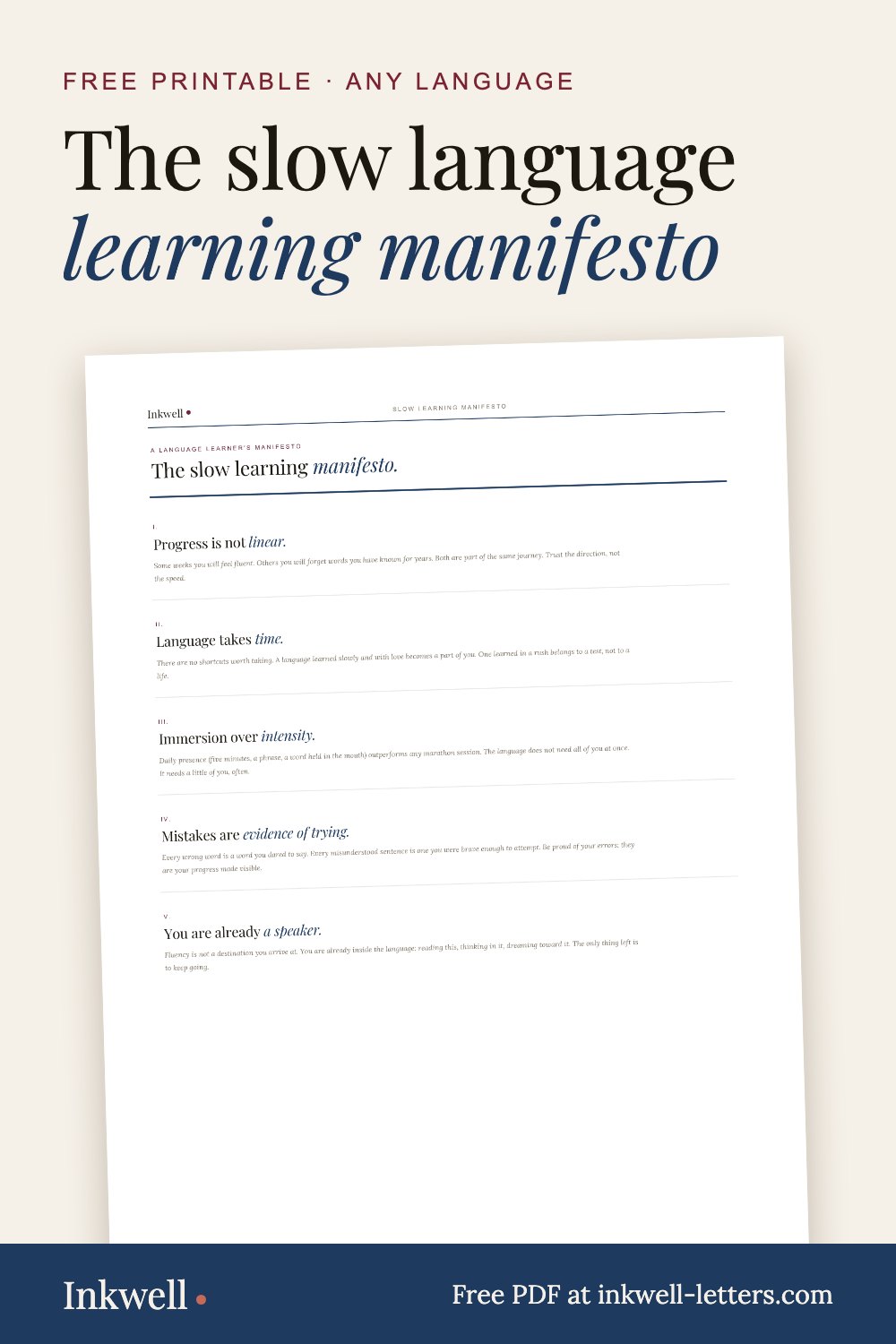 The Slow Language Learning Manifesto
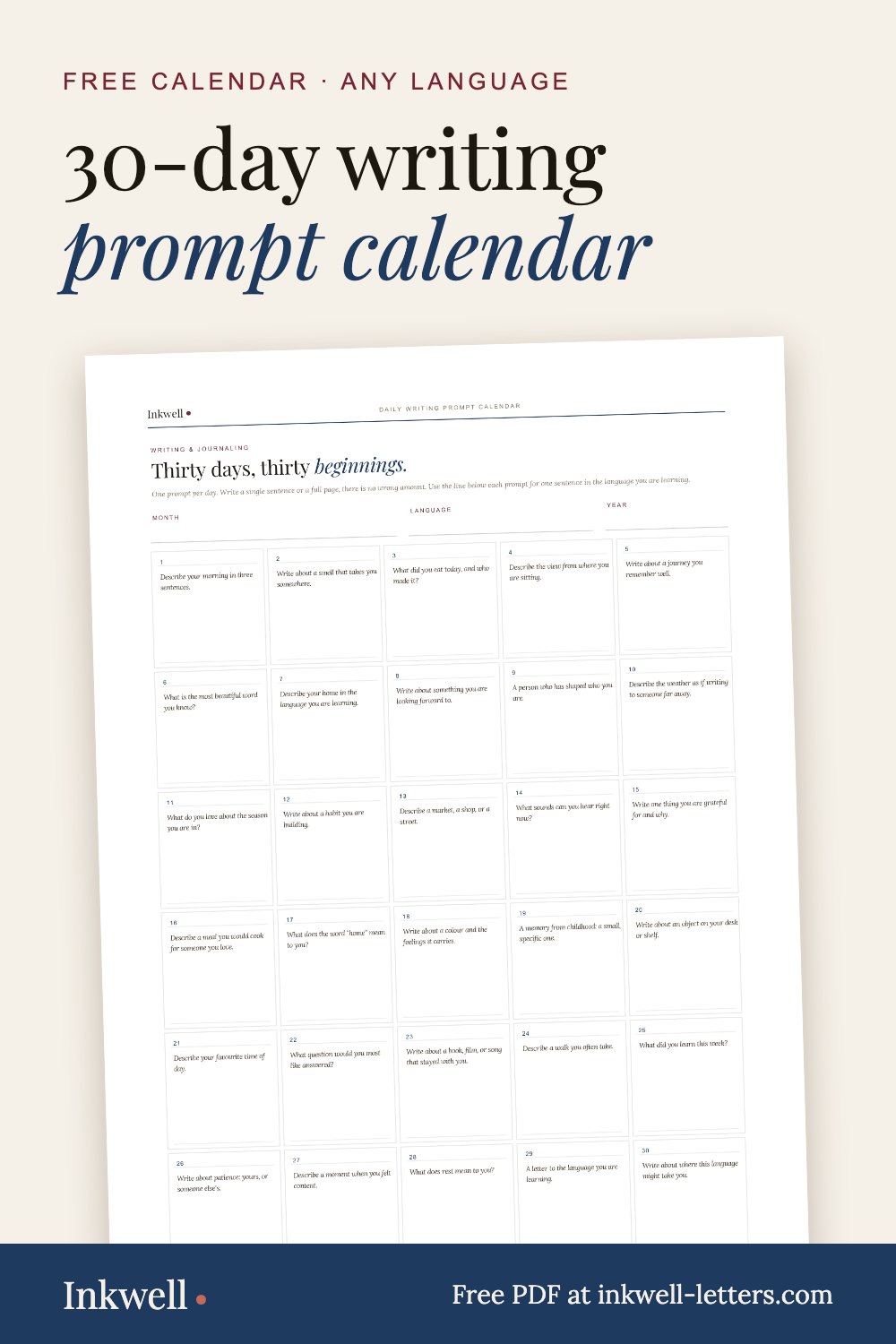 Thirty-Day Writing Prompt Calendar for Language Learners

Comments